Nitration of Benzene Revision Notes | A Level AQA Chemistry
In nitration, benzene's pi system attacks the nitronium ion, NO₂⁺, formed from concentrated nitric and sulphuric acids. Free notes and 11 questions answered.
Updated 5 Sept 2026 · Revise Right Team
Nitration of Benzene is part of Aromatic chemistry (A-level only) in A Level AQA Chemistry.
6 min
Reading time
81
Lessons in this topic
A Level AQA
Pathway
Reviewed by Revise Right
Content review
What this lesson covers
In nitration, benzene's pi system attacks the nitronium ion, NO₂⁺, formed from concentrated nitric and sulphuric acids. Free notes and 11 questions answered.
Explain how the nitronium ion is generated from a mixture of concentrated nitric acid and concentrated sulphuric acid
Describe the mechanism of electrophilic substitution in the nitration of benzene, including the role of the Wheland intermediate
Explain why electrophilic attack on benzene results in substitution rather than addition
Apply knowledge of nitration to its role in synthesis, including the manufacture of explosives and the formation of amines
Key ideas to keep in view
Use this lesson to stay inside Aromatic chemistry (A-level only) while connecting the detail back to the wider Organic chemistry topic.
Nitronium ion: The electrophile $\text{NO}_2^+$ generated when concentrated sulphuric acid protonates concentrated nitric acid, causing loss of water. It is the active species that attacks the benzene ring during nitration.
Electrophilic substitution: A reaction mechanism in which an electrophile replaces a hydrogen atom on an aromatic ring, restoring aromaticity after the initial attack. The driving force for substitution (rather than addition) is the recovery of the stable delocalised electron system.
Wheland intermediate: The positively charged, non-aromatic carbocation intermediate formed when the electrophile bonds to the benzene ring, disrupting delocalisation. It rapidly loses a proton to restore aromaticity.
Revision notes
Read the core explanations from Nitration of Benzene before testing yourself from memory.
1. Why Nitration of Benzene Matters
Benzene is famously unreactive towards the electrophilic addition reactions that alkenes undergo. Yet with the right reagent, you can attach a nitro group ($-\text{NO}_2$) to the ring — and that single transformation unlocks an enormous range of chemistry, from dyes and pharmaceuticals to explosives and amines.
Understanding nitration means understanding two things at once: how a powerful electrophile is generated, and why benzene's unique electronic structure forces the reaction to go via substitution rather than addition. Both ideas are examinable at A-level, and both reward careful mechanistic thinking.
2. Generating the Nitronium Ion
The nitrating mixture is made by combining concentrated nitric acid ($\text{HNO}_3$) with concentrated sulphuric acid ($\text{H}_2\text{SO}_4$). Sulphuric acid is a stronger acid than nitric acid, so it donates a proton to nitric acid — acting as the acid in a Brønsted–Lowry sense.
The protonated nitric acid then loses a water molecule, producing the nitronium ion, $\text{NO}_2^+$. This species carries a full positive charge and is a potent electrophile — exactly what is needed to attack the electron-rich benzene ring.
The overall equation for nitronium ion formation from the nitrating mixture.
$\text{NO}_2^+$: Nitronium ion — the electrophile that attacks benzene
$\text{HSO}_4^-$: Hydrogensulphate ion — the conjugate base of sulphuric acid
Notice that sulphuric acid is regenerated at the end of the overall reaction (it is consumed in generating $\text{NO}_2^+$ but the $\text{HSO}_4^-$ picks up the proton lost later in the mechanism). This is why sulphuric acid acts as a catalyst in the overall process.
3. The Electrophilic Substitution Mechanism
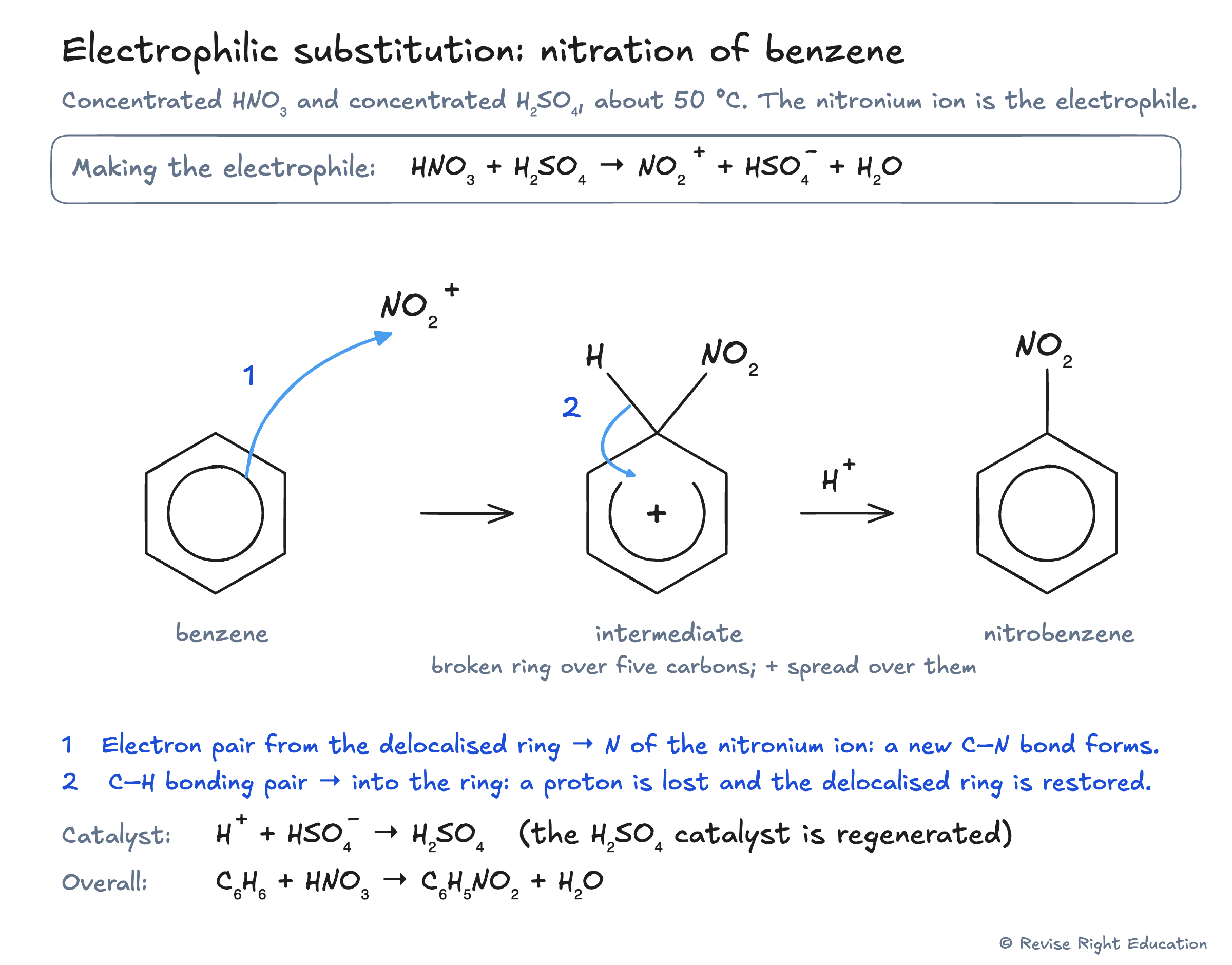
With the nitronium ion generated, the mechanism itself has two key stages. First, the electron-rich $\pi$ system of benzene donates two electrons to $\text{NO}_2^+$, forming a new C–N bond and creating a positively charged, non-aromatic intermediate. Second, that intermediate rapidly loses a proton to restore the aromatic ring.
The intermediate formed in the first stage is called the Wheland intermediate (sometimes called the arenium ion or sigma complex). At this point, the ring has lost its full delocalisation — four of the six $\pi$ electrons are now localised in two double bonds, and the positive charge is delocalised over three carbons of the ring (the arenium ion). The system is under energetic strain to recover aromaticity.
Nitration of benzene: the nitronium ion is made from the acids, attacked by the delocalised ring, and H+ is lost to restore the ring. The H2SO4 catalyst is regenerated.
The overall equation for the nitration of benzene is clean and worth memorising for the exam:
Benzene reacts with concentrated nitric acid in the presence of concentrated sulphuric acid at around 50 °C to give nitrobenzene and water.
$\text{C}_6\text{H}_5\text{NO}_2$: Nitrobenzene — a pale yellow liquid, the product of monosubstitution
3a. Why Substitution, Not Addition?
Alkenes undergo electrophilic addition because there is no special stability to lose — adding across the double bond converts $\text{sp}^2$ carbons to $\text{sp}^3$ carbons, and the product is more stable than the starting material. Benzene is fundamentally different.
The benzene ring possesses a delocalised $\pi$ system of six electrons spread over all six carbons. This delocalisation confers considerable thermodynamic stability — around 150 kJ mol$^{-1}$ more stable than a hypothetical cyclohexatriene. If addition occurred, that stabilisation would be permanently destroyed. Substitution, by contrast, restores the aromatic system in the second step, so the energetic cost is recovered.
The driving force for the second step (proton loss) is therefore the recovery of aromaticity. The Wheland intermediate is unstable precisely because it has lost full delocalisation, and losing $\text{H}^+$ is the fastest route back to stability.
4. Conditions for Nitration
The reaction is carried out at approximately 50 °C. This temperature is a deliberate compromise: warm enough to give a reasonable rate of reaction, but cool enough to prevent dinitration (the introduction of a second $-\text{NO}_2$ group). Above about 55 °C, the reaction becomes harder to control and dinitrobenzene forms in significant quantities.
Reagents: concentrated $\text{HNO}_3$ and concentrated $\text{H}_2\text{SO}_4$ (the nitrating mixture)
Temperature: approximately 50 °C (maintained carefully — use a water bath)
Product: nitrobenzene ($\text{C}_6\text{H}_5\text{NO}_2$) — a pale yellow liquid
Sulphuric acid is regenerated and acts as a catalyst overall
5. The Step-by-Step Mechanism Walkthrough
Mechanism questions in AQA A-level papers award marks for correct curly arrows, correct intermediates, and correct products. Here is a structured walkthrough of exactly what to draw and why each arrow goes where it does.
Worked example: Drawing the Nitration Mechanism for an AQA Exam
Outline the mechanism for the nitration of benzene using a mixture of concentrated nitric acid and concentrated sulphuric acid. Include the generation of the electrophile and all curly arrows. [5 marks]
$\text{HNO}_3 + \text{H}_2\text{SO}_4 \rightarrow \text{NO}_2^+ + \text{HSO}_4^- + \text{H}_2\text{O}$ — [B1] State that concentrated $\text{H}_2\text{SO}_4$ protonates $\text{HNO}_3$, which then loses water to give the nitronium ion $\text{NO}_2^+$. This is the electrophile. Always name it — examiners look for '$\text{NO}_2^+$' or 'nitronium ion'.
Arrow from the benzene $\pi$ system (drawn as a circle or as alternating double bonds) pointing towards the nitrogen atom of $\text{NO}_2^+$. — [M1] The arrow must start from the electron-rich benzene ring and end at the electrophilic N. A common error is drawing the arrow from a specific C–C bond rather than the $\pi$ system — either is acceptable, but the arrow must clearly show electrons moving from ring to electrophile.
A six-membered ring with the $\text{NO}_2$ group attached to one carbon, a hydrogen still on that carbon, a positive charge shown on the ring (delocalised over the remaining carbons), and two double bonds remaining in the ring. — [M1] The intermediate must show the ring is no longer fully aromatic — it has lost one $\pi$ electron pair to form the new C–N bond. The positive charge is delocalised over the remaining carbons. Examiners accept the charge shown on the carbon adjacent to the substituted carbon.
Arrow from the C–H bond (on the carbon bearing $\text{NO}_2$) pointing towards H, and then H is accepted by $\text{HSO}_4^-$ (or shown leaving as $\text{H}^+$). — [M1] This step restores aromaticity. The arrow starts from the C–H bond and points to the H atom. Some mark schemes also credit an arrow from H to the base ($\text{HSO}_4^-$). Either way, the key idea is that proton loss regenerates the delocalised ring.
Product: nitrobenzene $\text{C}_6\text{H}_5\text{NO}_2$. Sulphuric acid is regenerated: $\text{H}^+ + \text{HSO}_4^- \rightarrow \text{H}_2\text{SO}_4$. — [B1] Stating that $\text{H}_2\text{SO}_4$ is regenerated confirms your understanding that it acts as a catalyst. This is often worth a mark in longer questions asking you to 'explain the role of sulphuric acid'.
Answer: The nitronium ion ($\text{NO}_2^+$) attacks the benzene ring; the Wheland intermediate forms; loss of $\text{H}^+$ (accepted by $\text{HSO}_4^-$) restores aromaticity to give nitrobenzene. $\text{H}_2\text{SO}_4$ is regenerated.
6. Importance of Nitration in Synthesis
Nitration is not an end in itself — it is a gateway reaction. The $-\text{NO}_2$ group introduced onto the ring can be reduced to a primary amine ($-\text{NH}_2$), opening up a vast range of further chemistry. This reduction is typically carried out using tin and concentrated hydrochloric acid, or by catalytic hydrogenation.
Aromatic amines such as phenylamine (aniline, $\text{C}_6\text{H}_5\text{NH}_2$) are the starting materials for azo dyes and many pharmaceutical compounds. The sequence — nitration of benzene, then reduction of the nitro group — is one of the most important two-step routes in industrial organic chemistry.
At the other end of the application spectrum, polynitration of aromatic compounds produces explosives. Trinitrotoluene (TNT, 2,4,6-trinitrotoluene) is made by the controlled nitration of toluene (methylbenzene) three times in succession. The high nitrogen content and the energy released when the $\text{N}–\text{O}$ bonds break rapidly make these compounds powerful explosives. This is a direct industrial consequence of the electrophilic substitution chemistry you have just studied.
Application
Starting material
Key transformation
Product / use
Amine synthesis
Nitrobenzene ($\text{C}_6\text{H}_5\text{NO}_2$)
Reduction of $-\text{NO}_2$ to $-\text{NH}_2$
Phenylamine — dyes, pharmaceuticals
Explosives
Toluene (methylbenzene)
Repeated nitration (×3)
TNT — high explosive
Dye intermediates
Various arenes
Nitration then diazotisation
Azo dyes for textiles and food
Turn this lesson into flashcards, notes or a mind map
Test what you remember, then practise on real papers.
What is the mechanism for the nitration of benzene?
In the nitration of benzene, the pi system of the ring attacks the nitronium ion, NO₂⁺, forming a C–N bond and the positively charged Wheland intermediate. The C–H bond on that carbon then breaks, losing H⁺ to HSO₄⁻, which restores the aromatic ring and gives nitrobenzene, C₆H₅NO₂, while regenerating H₂SO₄.
What are the conditions for the nitration of benzene?
Benzene is nitrated with a mixture of concentrated nitric acid and concentrated sulphuric acid at about 50 °C, maintained using a water bath. This is warm enough for a reasonable rate but cool enough to prevent dinitration, which becomes significant from about 55 °C; the product is pale yellow nitrobenzene.
What is the overall equation for the nitration of benzene?
The overall nitration of benzene attaches a nitro group in place of one hydrogen, giving nitrobenzene, C₆H₅NO₂: C₆H₆ + HNO₃ → C₆H₅NO₂ + H₂O, using concentrated sulphuric acid as a catalyst at about 50 °C. Nitrobenzene is a pale yellow liquid.
How is TNT made?
TNT, 2,4,6-trinitrotoluene, is made by the controlled nitration of toluene, methylbenzene, three times in succession. The high nitrogen content and the energy released when the N–O bonds break rapidly make polynitrated compounds powerful explosives.
What is nitrobenzene used to make?
Nitrobenzene is used to make phenylamine, C₆H₅NH₂, by reducing its –NO₂ group to –NH₂, typically with tin and concentrated hydrochloric acid or catalytic hydrogenation. Aromatic amines like phenylamine are starting materials for azo dyes and many pharmaceuticals.
How is the nitronium ion formed?
The nitronium ion, NO₂⁺, forms when concentrated sulphuric acid, the stronger acid, protonates concentrated nitric acid, which then loses water: HNO₃ + H₂SO₄ → NO₂⁺ + HSO₄⁻ + H₂O. NO₂⁺ carries a full positive charge, making it a powerful electrophile.
What is the role of sulphuric acid in nitration?
Concentrated sulphuric acid acts as a catalyst in nitration. It protonates nitric acid to generate the nitronium ion, NO₂⁺, and is regenerated at the end when HSO₄⁻ accepts the proton lost from the Wheland intermediate: H⁺ + HSO₄⁻ → H₂SO₄.
Why is the nitration of benzene important?
Nitration is a gateway reaction: the –NO₂ group can be reduced to –NH₂, for example with tin and concentrated hydrochloric acid, giving aromatic amines such as phenylamine for azo dyes and pharmaceuticals. Repeated nitration of methylbenzene produces explosives such as TNT, 2,4,6-trinitrotoluene.
What happens if nitration of benzene is done above 55 °C?
If benzene is nitrated at more than about 55 °C, the reaction becomes harder to control and dinitrobenzene forms in significant quantities, as a second –NO₂ group is introduced. About 50 °C is used, in a water bath, to give a reasonable rate while preventing dinitration.
What does nitrobenzene look like?
Nitrobenzene, C₆H₅NO₂, is a pale yellow liquid. It is made by nitrating benzene with a mixture of concentrated nitric and sulphuric acids at about 50 °C.
Why is the Wheland intermediate in nitration unstable?
The Wheland intermediate in nitration is unstable because the ring has lost full delocalisation: four of the six pi electrons are localised in two double bonds and the positive charge is spread over three carbons. Losing H⁺, accepted by HSO₄⁻, is the fastest route back to an aromatic ring.